




Monday, 27 July 2026 11:30 AM
Product Announcements
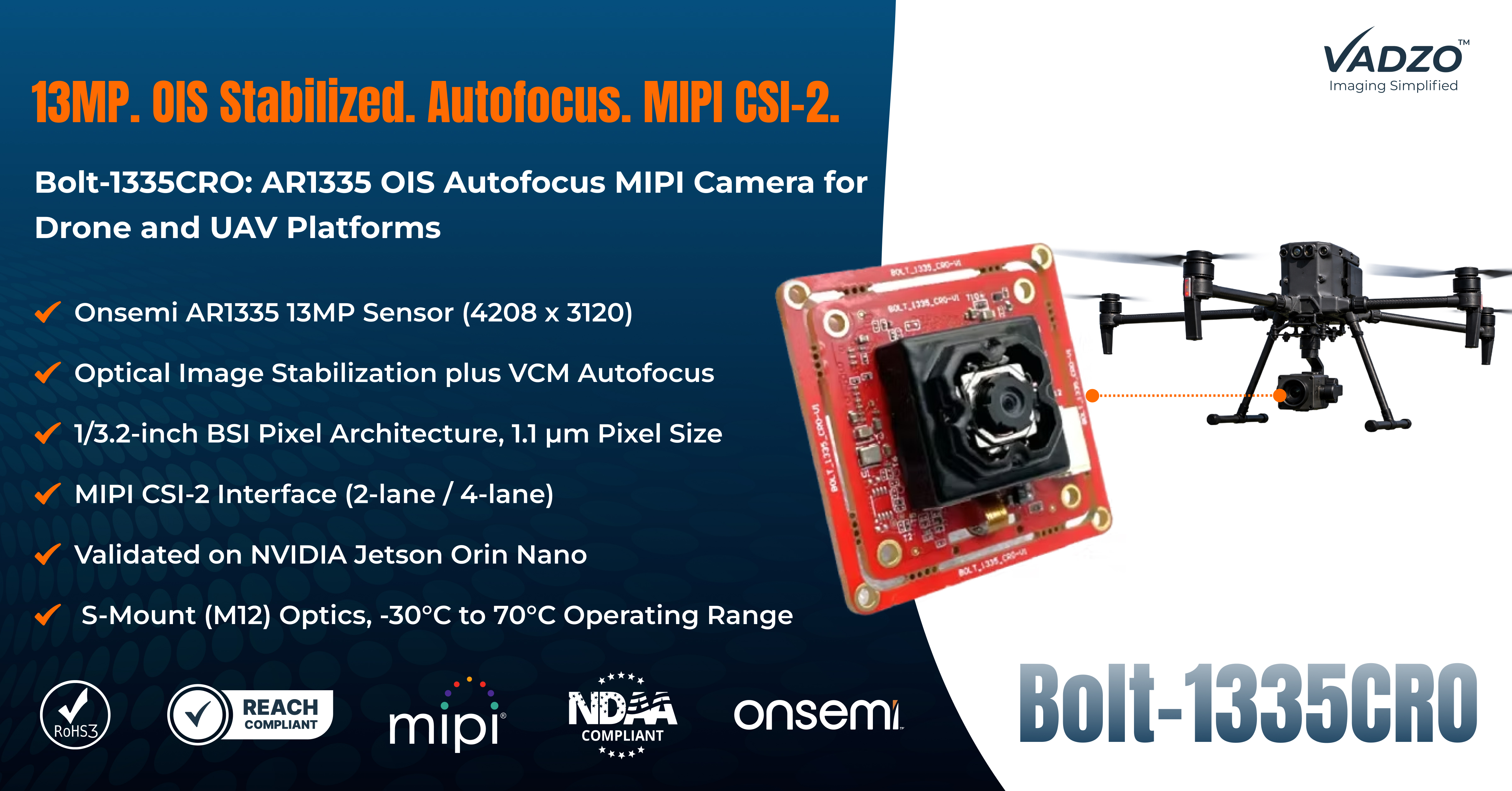
Vadzo Imaging has completed platform validation of the Bolt-1335CRO, a 13MP AR1335 OIS Autofocus MIPI Camera combining voice coil motor autofocus and optical image stabilization on NVIDIA Jetson Orin Nano. The module addresses the vibration-induced blur and continuously changing working distance that OEM developers face when deploying a high-resolution autofocus MIPI camera on drone and UAV imaging payloads. Built on the Onsemi AR1335 sensor with MIPI CSI-2 output, the Bolt-1335CRO targets aerial mapping, infrastructure inspection, precision agriculture, and gimbal-stabilized surveillance platforms that require stabilized 4K image capture in a board-level embedded form factor.
FORT WORTH, TX / ACCESS Newswire / July 27, 2026 / Vadzo Imaging, a developer of OEM embedded camera products for industrial and embedded vision applications, today announced validation of the Bolt-1335CRO, an AR1335 OIS Autofocus Camera qualified on NVIDIA Jetson Orin Nano for drone and UAV imaging platforms. The validation addresses the stabilization and focus requirements that separate ground-based machine vision deployments from airborne imaging payloads subject to rotor vibration, wind-induced platform motion, and continuously changing subject distance.
The Stabilization and Focus Challenge in Drone and UAV Camera Payloads
Airborne imaging platforms introduce two engineering problems that ground-mounted machine vision systems rarely encounter at the same severity. The first is high-frequency vibration transmitted from the propulsion system and airframe into the camera payload, a disturbance that a gimbal's mechanical stabilization dampens at low frequencies but often cannot fully cancel at the higher frequencies generated by motor and rotor harmonics. A rolling shutter sensor capturing this residual vibration produces frame-level blur and geometric skew that degrades tasks ranging from orthomosaic stitching to defect detection.
The second problem is continuously changing working distances. A drone climbing from a low-altitude inspection pass to a higher-altitude mapping pass shifts the subject distance by tens or hundreds of meters within seconds, and a fixed-focus 4K drone camera cannot track that change. For AR1335 drone camera and AR1335 UAV camera deployments built on a 13MP sensor, this focus error is magnified because higher pixel density makes any defocus more visually apparent at the pixel level.
OEM developers building drone gimbal stabilization camera systems and UAV payload camera platforms need both problems solved at the optical and sensor level before the frame reaches the flight computer's inference pipeline, not corrected afterward in software.
Why Optical Image Stabilization and Autofocus Must Operate at the Lens Module Level
Correcting vibration and focusing error on software after capturing is a common workaround, but it carries real costs. Digital stabilization crops the frame to compensate for motion, discarding field of view, and reducing the effective resolution delivered to the inference engine. Software-based sharpening cannot recover detail lost to genuine optical defocus, and both approaches add processing load to a power and thermal budget as tight as an NVIDIA Jetson Orin Nano payload on a UAV.
The Bolt-1335CRO addresses both problems before the sensor exposes a frame. Optical image stabilization shifts the lens element to counteract high-frequency vibration in real time, correcting the disturbance at the optical path rather than in a downstream processing stage. This complements, rather than duplicates, the lower-frequency mechanical stabilization a gimbal already provides, closing the gap that residual motor and rotor vibration leaves behind. Voice coil motor autofocus operates alongside the stabilization actuator, continuously adjusting lens position as working distance changes with altitude, flight attitude, or gimbal tilt, so the AR1335 sensor delivers a sharp frame across the full range of a mission profile.
Because both corrections happen at the lens module before the MIPI CSI-2 interface delivers pixel data to the SoC, the OIS autofocus MIPI camera preserves full field of view and full native resolution in every frame, leaving the Jetson Orin Nano's compute budget available for object detection, mapping, or navigation inference rather than motion compensation.
Bolt-1335CRO: AR1335 OIS Autofocus MIPI Camera Overview
The Bolt-1335CRO is built on the Onsemi AR1335, a 1/3.2-inch back-side illuminated CMOS sensor with 1.1 µm pixel pitch delivering 13MP resolution at 4208 x 3120. The AR1335's BSI architecture improves photon collection per pixel relative to front-side illuminated designs, supporting usable image quality during dawn and dusk mapping flights and shaded infrastructure inspection passes. Rolling shutter readout keeps the module compact and power-efficient for weight-constrained UAV payloads, with the OIS actuator addressing the vibration-related distortion that a global shutter would otherwise be needed to avoid.
As a 13MP 4K MIPI Camera with native MIPI CSI-2 output, the Bolt-1335CRO connects directly to the host SoC's ISP with a direct pixel path and no added driver or network stack overhead, a timing advantage for closed-loop flight control and real-time inference. The module is validated on NVIDIA Jetson Orin Nano, extending Vadzo's existing Bolt series driver support for the broader Jetson Orin family and Raspberry Pi platforms. Board-level construction and S-Mount (M12) optics give OEM integrators flexibility to select lens configurations for mapping, inspection, or gimbal-mounted surveillance without a sensor redesign.
Key Capabilities of the Bolt-1335CRO
Optical Image Stabilization for Vibration-Free Aerial Capture: The OIS actuator in the Bolt-1335CRO shifts the lens element to compensate for high-frequency vibration transmitted through the airframe and gimbal mount. Correcting residual motion, a gimbal's mechanical stabilization cannot fully cancel. For embedded OIS camera deployments on multi-rotor UAV platforms, this reduces frame-level blur that otherwise corrupts orthomosaic stitching accuracy and obscures fine surface detail in inspection. As an optical image stabilization MIPI camera, the module delivers this correction at the optical path, ahead of software-based motion compensation.
VCM Autofocus for Variable Altitude and Working Distance: A voice coil motor moves the AR1335's lens element to maintain focus as working distance changes with altitude, gimbal tilt, or flight attitude, a condition fixed-focus modules cannot track. For AR1335 aerial imaging camera and AR1335 gimbal camera deployments spanning multiple altitudes in a single mission, this keeps every frame in focus without requiring recalibration between passes. As an autofocus MIPI CSI camera, the Bolt-1335CRO extends the same VCM autofocus approach validated across Vadzo's Bolt MIPI camera portfolio to this OIS-enabled configuration suited for direct SoC integration.
13MP AR1335 Sensor Resolution and BSI Pixel Architecture: At 13MP (4208 x 3120), the AR1335 gives OEM teams building AR1335 drone imaging camera and precision agriculture drone camera platforms enough pixel density to resolve fine crop-level and structural detail from typical mapping altitudes without cropping into a lower effective resolution. The 1.1 µm BSI pixel architecture improves low-light sensitivity relative to front-side illuminated sensors of comparable pixel pitch, a meaningful factor for early-morning agricultural flights and shadowed inspection environments. As a 13MP Color MIPI Camera, the sensor outputs full-resolution color frames suited to both AI-based classification and direct visual review.
MIPI CSI-2 Integration with NVIDIA Jetson Orin Nano: The Bolt-1335CRO connects to the host SoC over a 2-lane or 4-lane MIPI CSI-2 interface, validated on NVIDIA Jetson Orin Nano alongside the broader Bolt series driver support for Jetson Orin NX, Jetson Orin AGX, Raspberry Pi 4, Raspberry Pi 5, and NXP i.MX8M Plus. For Jetson Orin Nano camera module and Orin Nano MIPI camera integrations on weight and power-constrained UAV compute payloads, this 4K autofocus MIPI camera delivers pixel data directly to the SoC ISP, avoiding the added driver and enumeration overhead that a non-native camera interface would introduce into the flight computer's frame pipeline.
Bolt-1335CRO Product Specifications
Parameter | Specification |
Sensor | Onsemi AR1335 |
Sensor Format | 1/3.2 inch BSI CMOS |
Resolution | 13MP (4208 x 3120) |
Pixel Size | 1.1 µm x 1.1 µm |
Shutter Type | Rolling Shutter |
Focus and Stabilization | VCM Autofocus with Optical Image Stabilization (OIS) |
Interface | MIPI CSI-2 (2-lane / 4-lane) |
Optics | S-Mount (M12 Standard) |
Operating Temperature | -30°C to 70°C |
Validated Platform | NVIDIA Jetson Orin Nano, with Bolt series driver support extending to Jetson Orin NX, Jetson Orin AGX, Raspberry Pi 4, Raspberry Pi 5, and NXP i.MX8M Plus |
SDK | VISPA ARC (C, C++, C#, Python APIs) |
"Drone and UAV imaging payloads ask a camera module to solve two problems simultaneously, vibration and continuously changing focus distance, on a platform where every gram and milliwatt is contested. The Bolt-1335CRO's OIS actuator and VCM autofocus solve both at the lens module, ahead of the ISP, so the Jetson Orin Nano on the airframe spends its compute budget on mapping and inspection inference instead of correcting motion artifacts in post-processing. That is the distinction that matters for OEM teams building production aerial imaging systems on a 13MP AR1335 platform." - Alwin Vincent, Product Manager, Vadzo Imaging
Target Applications
Aerial Mapping and Precision Agriculture: Orthomosaic mapping and NDVI-based crop health analysis both depend on frame-to-frame geometric consistency across a flight path, a requirement that vibration-induced blur and focus drift directly undermine. As a aerial mapping camera built on a 13MP AR1335 sensor, the Bolt-1335CRO delivers OIS-corrected frames with VCM autofocus tracking altitude changes across a single mission, reducing the stitching artifacts and soft-focus tiles that degrade output in precision agriculture drone camera deployments. For fixed-wing and multi-rotor platforms flying variable-altitude survey grids, maintaining focus and stabilization without manual recalibration shortens mission planning time and improves usable frame yield.
UAV Infrastructure Inspection: Inspecting bridges, transmission towers, wind turbine blades, and pipeline corridors requires close-range imaging where platform vibration and rapidly changing standoff distance are constant conditions rather than occasional disturbances. A drone inspection camera built on the Bolt-1335CRO's OIS and autofocus combination keeps fine surface defects, corrosion, and hairline cracking resolvable at the pixel level as the UAV adjusts distance to maintain a safe standoff from the structure. The AR1335's 13MP resolution gives inspection teams the pixel density needed to detect sub-millimeter defects, reducing repeated passes to compensate for missed or blurred frames.
Gimbal-Stabilized Aerial Surveillance and Security: Security and perimeter monitoring platforms mounted on UAV gimbals require UAV Surveillance camera modules that maintain subject focus and frame stability as the aircraft holds position in variable wind or tracks a moving subject at changing range. The Bolt-1335CRO's OIS actuator addresses residual high-frequency vibration a gimbal's mechanical stabilization does not fully absorb, while VCM autofocus keeps the subject sharp as tracking distance changes during a loiter or pursuit profile. For OEM teams building AR1335 drone vision camera payloads for border monitoring or critical infrastructure security, this combination reduces false negatives caused by motion blur in downstream video analytics.
Smart City and Environmental Monitoring Drones: Municipal UAV programs used for traffic flow analysis, environmental compliance monitoring, and construction progress tracking benefit from a 4K OIS camera that delivers consistent, stabilized imagery across repeated survey flights over the same urban area. The Bolt-1335CRO's combination of 13MP resolution, optical image stabilization, and MIPI CSI-2 integration with NVIDIA Jetson Orin Nano supports on-board inference for vehicle counting and construction progress verification without offloading raw video to ground infrastructure. As a 4K optical image stabilization camera validated for embedded Linux platforms, the module fits directly into smart city UAV programs built around edge processing.
Robotics and Edge AI Payload Integration on NVIDIA Jetson Orin Nano: Beyond fixed-wing and multi-rotor aircraft, the Bolt-1335CRO's compact board-level form factor and native MIPI CSI-2 interface suit any weight and power-constrained robotics payload built around NVIDIA Jetson Orin Nano, including tethered inspection drones, robotic arms mounted on mobile UAV docking stations, and hybrid ground-air inspection robots. As an OEM MIPI autofocus camera validated on the same Jetson Orin Nano platform used across Vadzo's Bolt camera portfolio, the module gives OEM integrators a single qualified imaging platform to standardize across airborne and ground-based robotics programs.
VISPA ARC SDK for OIS and Autofocus Control
Beyond the standard V4L2 driver and device tree overlay that bring the Bolt-1335CRO up on NVIDIA Jetson Orin Nano, Vadzo provides the VISPA ARC SDK for applications that need direct programmatic control over OIS actuation, autofocus behavior, ROI configuration, and other functions outside the default V4L2 capture path. The SDK exposes C, C++, C#, and Python APIs, letting flight computer software trigger autofocus at specific mission waypoints, adjust ROI windowing to reduce bandwidth on constrained data links, or synchronize capture with GPIO signals from the flight controller.
For OEM teams building Custom MIPI Camera for drones integrations where the standard capture pipeline needs mission-specific behavior, such as autofocus lockout during a mapping pass, VISPA ARC provides that control without a custom kernel driver. The SDK installs alongside the native V4L2 stream, so standard capture continues to function for teams that do not need the extended control layer. Full SDK documentation is available directly from Vadzoimaging.com.
Frequently Asked Questions
Q: What is optical image stabilization and why does it matter for drone camera systems?
A: Optical image stabilization corrects camera shake at the lens level by shifting a lens element in response to detected motion, rather than cropping or digitally warping the frame after exposure. On a drone or UAV platform, this matters because a gimbal's mechanical stabilization typically dampens low-frequency motion but leaves higher-frequency vibration from motors and rotors uncorrected, and that residual vibration is exactly what produces blur on a rolling shutter sensor. Vadzo Imaging's Bolt-1335CRO addresses this gap directly. Built on the Onsemi AR1335 13MP sensor, the module combines an OIS actuator with voice coil motor autofocus in a single MIPI CSI-2 camera validated on NVIDIA Jetson Orin Nano. For OEM teams building OIS camera payloads for aerial mapping, inspection, or surveillance, this means vibration correction happens optically, before the frame reaches the flight computer, preserving full resolution and field of view rather than sacrificing either to a digital stabilization crop. Learn more about the OIS Autofocus MIPI Camera.
Q: How does autofocus work in a MIPI camera module used on changing-altitude drone missions?
A: A MIPI camera module with voice coil motor autofocus moves its lens element along the optical axis using an electromagnetic coil, adjusting focus in response to an onboard contrast-detection algorithm or a direct command from the host system. On a drone mission where altitude changes continuously between takeoff, cruise, and close-range inspection passes, this lets the module maintain focus without manual optics adjustment between segments of the same flight. Vadzo Imaging's Bolt-1335CRO applies this VCM autofocus approach to a 13MP AR1335 MIPI CSI-2 camera validated on NVIDIA Jetson Orin Nano, pairing it with optical image stabilization so both the focus and vibration problems specific to airborne payloads are addressed in the same module, unlike fixed-focus MIPI modules designed for stationary machine vision at a constant working distance.
Q: Which MIPI camera module is validated for NVIDIA Jetson Orin Nano drone and UAV payloads?
A: For OEM teams selecting a MIPI camera module for an NVIDIA Jetson Orin Nano-based drone or UAV payload, the Bolt-1335CRO from Vadzo Imaging is built specifically for this deployment profile. It combines a 13MP Onsemi AR1335 sensor with optical image stabilization and voice coil motor autofocus, delivering stabilized, in-focus frames over a native MIPI CSI-2 interface with a direct pixel path into the flight computer's capture pipeline. The module is validated on NVIDIA Jetson Orin Nano, extending the same Bolt series driver support Vadzo provides for Jetson Orin NX, Jetson Orin AGX, Raspberry Pi 4, Raspberry Pi 5, and NXP i.MX8M Plus. For OEM developers who need a qualified OIS Autofocus MIPI Camera rather than an unproven sensor and lens combination, the Bolt-1335CRO gives Jetson Orin Nano-based aerial imaging programs a validated starting point. View the AR1335 Color 4K MIPI Camera product page.
Q: What resolution and sensor specifications should OEM teams look for in an aerial mapping camera module?
A: The core specifications to evaluate are pixel count relative to mission altitude, pixel size for low-light sensitivity during early morning or overcast flights, shutter architecture relative to platform vibration, and whether focus and stabilization are handled optically or left to post-processing. A higher pixel count without adequate pixel size or stabilization can produce more detailed but also more visibly blurred frames. Vadzo Imaging's Bolt-1335CRO covers these requirements with a 13MP Onsemi AR1335 sensor at 1.1 µm BSI pixel size, combined with optical image stabilization and VCM autofocus in a single MIPI CSI-2 module validated on NVIDIA Jetson Orin Nano. As a 13MP 4K Color Camera purpose-built for airborne deployment, it gives OEM mapping and survey developers a sensor and stabilization combination matched to the vibration and altitude conditions specific to UAV missions.
Q: What is the difference between OIS and gimbal-based mechanical stabilization on a drone camera payload?
A: Gimbal-based mechanical stabilization uses motors and inertial sensors to counteract the aircraft's roll, pitch, and yaw, keeping the camera pointed at a stable target across slow, large-amplitude motion. Optical image stabilization corrects high-frequency, small-amplitude vibration from motor and rotor harmonics that the gimbal's servo response is too slow to cancel. The two systems are complementary rather than redundant. Vadzo Imaging's Bolt-1335CRO applies OIS at the lens module level specifically to address the residual vibration that passes through a gimbal's mechanical stabilization, so that an OIS Autofocus MIPI Camera mounted on a stabilized gimbal still delivers a sharp frame rather than relying on the gimbal alone to remove every source of motion in the imaging path.
Availability
The Bolt-1335CRO AR1335 OIS Autofocus MIPI Camera is available for evaluation and design-in through Vadzo Imaging, with Jetson Orin Nano driver packages, device tree overlays, and VISPA ARC SDK documentation provided to OEM engineering teams. Production quantities and custom lens configurations are available for volume drone and UAV programs. Additional information on the OIS Autofocus MIPI Camera and Vadzo's broader MIPI CSI-2 camera portfolio is available at vadzoimaging.com.
About Vadzo Imaging
Vadzo Imaging develops OEM embedded camera products for industrial and embedded vision applications, offering imaging platforms across MIPI, GigE, Wi-Fi, and SerDes interfaces. The company's camera portfolio spans board-level and enclosed camera products supporting industrial automation, robotics, drone and UAV imaging, security and surveillance, and healthcare deployments. Vadzo works directly with OEM teams on platform validation, driver development, and custom optics and firmware configuration. Additional information is available at vadzoimaging.com.
Media Contact
Alwin Vincent
Vadzo Imaging
Email: [email protected]
LinkedIn: Vadzo Imaging
YouTube: Vadzo Imaging
X: Vadzo Imaging
SOURCE: Vadzo Imaging